
Are you wondering which integration service is the best fit for your needs? Are you familiar with the distinctions between Native, Custom, and iPaaS integration? How can implementing iPaaS benefit your business? Let’s learn more.
Integration, or iPaaS, refers to a set of tools that automate the process of connecting software applications that are hosted in different environments. These tools are commonly used by B2B companies, both large and small, to link their local web applications and data with those hosted in the cloud. iPaaS, or Integration Platform as a Service, provides a streamlined way for businesses to manage these connections and ensure smooth communication between systems.
There’s more. To make handling APIs and building integration workflows easier, an iPaaS platform often provides pre-built connectors, maps, business rules, and transformations. Custom development kits are also offered by some iPaaS vendors to connect legacy systems to mobile and social applications. Tools to control data quality are among the other common aspects.
Let us explain. iPaaS is frequently used in B2B scenarios where quick response times and task automation are crucial. Utilizing a third-party iPaaS vendor, even though internal IT personnel might be competent to manage integrations.
Get Started with Aonflow iPaaS – Free Trial Available!
Build and deploy your integrations at zero cost. No credit card required!
Which Integration Is Best for Your Business/Organization?
Before we jump into this, we would like to first talk about integrations- what they are, how they differ, and which integration is best for you.
There are three types of integrations:
- Native Integrations
- Custom Integrations
- iPaaS
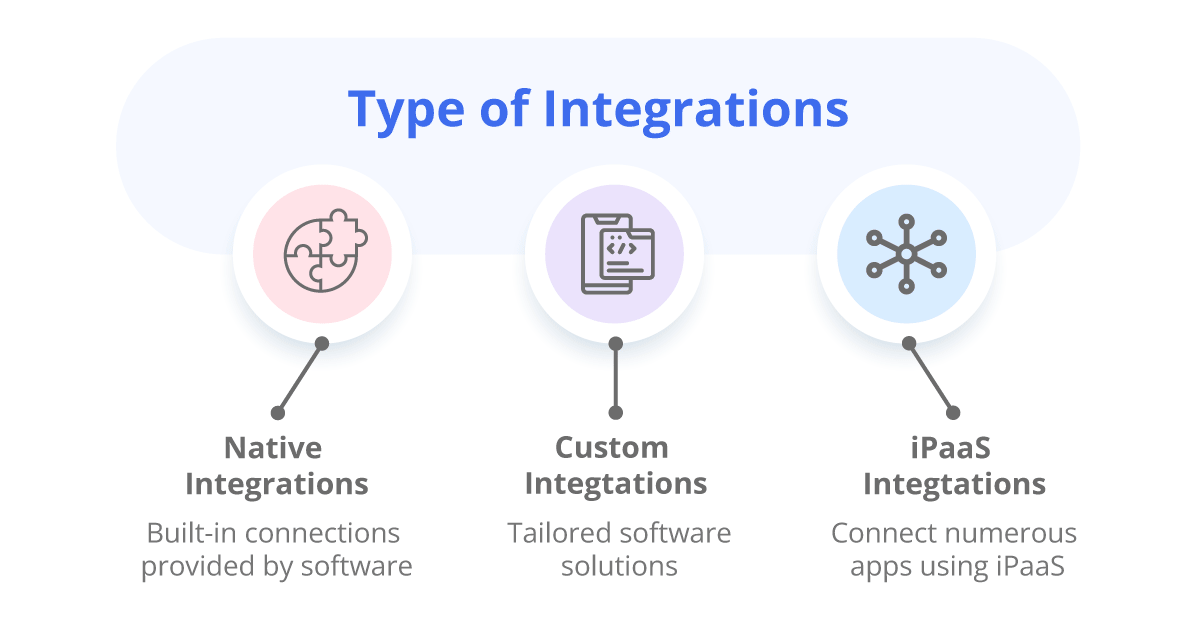
Determining the best integration solution for your needs requires understanding the different types of integrations available. Before we delve into talking more about the different types of iPaaS, let’s review the basics of integrations, including the differences between them.
What are Native Integrations?
Native Integrations are built-in connections provided by software providers that allow data to be shared and used between different web applications or programs. These integrations enhance the user experience and functionality by using input from one application to improve the performance of another.
The benefits of Native Integrations include access to extensive documentation, reliable support, typically no cost, and a simple setup process.
How do Native Integrations benefit your business/organization?
Native Integrations can support your business by providing access to well-documented resources, dependable support from software providers, and no additional cost. Additionally, setting up the integration is usually a straightforward process.
For example, native integrations can:
- Connect customer relationship management (CRM) software to accounting software, allowing businesses to track sales and financial data in one centralized location.
- Integrate a marketing automation tool with a social media management platform, allowing businesses to track and analyze social media engagement, and use that data to improve marketing campaigns.
- Connect project management software with a collaboration tool, allowing teams to share and access important project information in real time, streamlining communication and increasing productivity.
What Are Custom Integrations?
Software solutions that are made specifically for particular use cases are referred to as custom integrations. This might be anything from a simple data transfer plugin to a unique content management system. Since each integration is different, they are all created using APIs and can take different lengths of time to complete. The use of APIs, which serve as connection pins, enables them to facilitate communication between various pieces of software. To enable data flow between apps, a developer writes a piece of middleware software that makes use of these connector ports.
How Do Custom Integrations Support Your Organization/Business?
Custom Integrations can support your business by allowing for tailored software solutions that specifically meet the unique needs of the organization. Custom integrations can be built using APIs, which act as connector pins to allow different software to communicate with each other.
Here are a few examples of how custom integrations can support your business:
- A custom integration can be built to connect a legacy system to a newer, more advanced system, allowing for continued use of valuable data stored in the legacy system.
- Custom integration can be developed to connect a company’s in-house software to a third-party platform, allowing for seamless data transfer and improved workflow.
- Custom integration can be created to connect multiple systems within an organization, automating data transfer and reducing the need for manual data entry. This can improve accuracy and efficiency, saving time and money.
- Custom integrations can be designed to connect with external partners, suppliers, and customers to manage the flow of information, improving collaboration, and increasing the overall efficiency of business operations.
Aonflow is the leading integration platform.
You can kick-start by integrating your first-ever workflow in just a matter of minutes.
What Does An iPaaS Do?
In a digital era where all of your software is already available as a service in the cloud, it only makes sense to take into account iPaaS. You can connect numerous apps using iPaaS platforms. They include “connectors” to a variety of apps that let you connect one app to another.

How Can iPaaS Benefit Your Company/Business?
You have the freedom to scale and grow more effectively with iPaaS. You can dynamically select the apps for your software bundle, and iPaaS gives you the adaptability to scale your company and improve its growth.
Now that you have a fair knowledge of the different types of integrations, let’s delve into the different types of iPaaS and help you figure out which one is best suited for your business/organization.
Cloud-based iPaaS: It is a type of iPaaS that is delivered and accessed through the cloud. It allows businesses to connect and manage various applications, systems, and data sources through a cloud-based platform.
One of the main advantages of cloud-based iPaaS is its flexibility. As it is hosted in the cloud, businesses can access it from anywhere with an internet connection. This allows for seamless integration and management of systems, even for businesses with remote employees or multiple locations.
Cloud-based iPaaS also eliminates the need for businesses to invest in expensive hardware and IT infrastructure. As the platform is maintained and updated by the provider, businesses can focus on using the platform instead of managing it.
Another advantage of cloud-based iPaaS is scalability. Businesses can easily scale their usage up or down as needed. This can be particularly beneficial for businesses that experience seasonal or unpredictable changes in demand.
Cloud-based iPaaS also offers a cost-effective solution for businesses. As it is a subscription-based service, businesses only pay for what they use. This eliminates the need for large upfront investments and allows businesses to better manage their IT costs. These platforms offer pre-built connectors, drag-and-drop interfaces, and advanced features such as data mapping and transformation.
On-premises iPaaS: It is a type of iPaaS that is installed and managed on the customer’s own infrastructure. It allows businesses to connect and manage various applications, systems, and data sources through a platform that is hosted within their network.
One of the main advantages of on-premises iPaaS is the level of control and customization it offers. As the platform is installed on the customer’s infrastructure, businesses have full control over the platform and can customize it to their specific needs.
On-premises iPaaS also allows businesses to keep sensitive data within their network. This can be particularly beneficial for businesses in regulated industries or those that handle sensitive information. It can also be a cost-effective solution for businesses. As it is a one-time purchase, businesses can save money in the long run when compared to subscription-based cloud-based services.
Data Integration iPaaS: It is a type of iPaaS that is specifically designed for data integration. It allows businesses to connect, integrate and manage data from various sources through a single platform.
One of the main advantages of data integration iPaaS is that it allows businesses to have a unified view of their data. This can be particularly beneficial for businesses that have multiple systems and applications that store data in different formats and structures. With data integration iPaaS, businesses can standardize and cleanse their data, making it easier to access, analyze and make decisions based on it.
Data integration iPaaS also allows businesses to automate data integration processes. This can help to reduce errors and improve efficiency, as well as free up resources that would otherwise be spent on manual data integration tasks.
Another advantage of data integration iPaaS is that it can help businesses to comply with data governance and compliance regulations. With the ability to control data access, security, and encryption, businesses can ensure that their data is being handled in a compliant manner.
Process integration iPaaS: It is a type of iPaaS that is specifically designed for process integration. Through a single platform, it enables enterprises to integrate, automate, and manage business processes.
One of the key benefits of process integration iPaaS is that it enables organizations to automate routine, manual operations, which can enhance productivity and lower error rates. It can, for instance, automate procedures like lead generation, customer segmentation, and billing.
With this type of iPaaS, Sales and customer service can improve, and teams can collaborate more efficiently by connecting and automating operations across several systems, which leads to a workflow that is more seamless and efficient.
API integration iPaaS: It is a type of iPaaS that is specifically designed for API integration. It allows businesses to connect and manage their APIs (Application Programming Interface) through a single platform.
One of the main advantages of API integration iPaaS is that it allows businesses to connect different systems and applications easily and quickly. This can help to improve efficiency, as data can be easily shared and integrated across different systems. For example, businesses can use API integration iPaaS to connect their CRM system to their e-commerce platform, allowing them to share customer data and automate processes such as order processing and invoicing.
B2B Integration iPaaS: It allows businesses to automate and streamline their B2B processes. For example, businesses can use B2B integration iPaaS to automate the process of sending and receiving purchase orders, invoices, and shipping notices between their systems and those of their partners or suppliers.
B2B integration iPaaS also allows businesses to improve collaboration and communication between different departments and with their partners and suppliers. Another advantage of B2B integration iPaaS is that it can help businesses to comply with EDI (Electronic Data Interchange) standards.
Hybrid integration iPaaS: It allows businesses to leverage the benefits of both cloud and on-premises systems. For example, businesses can use cloud-based systems for scalability and cost-effectiveness, while maintaining sensitive data on-premises for compliance and security reasons. Hybrid integration iPaaS allows businesses to connect these systems seamlessly and manage the data flow between them.
How can businesses or organizations benefit from all these types of iPaaS?
Businesses need different types of iPaaS for different reasons. Some businesses may prefer a cloud-based solution for its scalability and cost-effectiveness, while others may require an on-premises solution for data security and compliance. Some businesses may focus on data integration while others may focus on process integration.
Cloud-based iPaaS: Businesses that want to take advantage of the scalability and cost-effectiveness of cloud-based systems, while maintaining sensitive data on-premises for compliance and security reasons may prefer cloud-based iPaaS.
On-Premises iPaaS: Businesses that want to have more control over their data and integration processes, and ensure their compliance and security requirements are met, may prefer on-premises iPaaS.
Data integration iPaaS: Businesses that want to gain access to accurate and timely data to make better decisions, improve customer service, and increase sales, may prefer data integration iPaaS.
Process integration iPaaS: Businesses that want to automate their processes and improve efficiency and reduce errors, resulting in a smoother and more streamlined workflow, may prefer process integration iPaaS.
API integration iPaaS: Businesses that want to connect different systems, applications, and services, and automate data flow between them, resulting in better data management and improved customer service, may prefer API integration iPaaS.
B2B integration iPaaS: Businesses that want to automate and streamline their B2B processes, improve efficiency, reduce errors, and ensure compliance, may prefer B2B integration iPaaS.
Hybrid integration iPaaS: Businesses that want to leverage the benefits of both cloud and on-premises systems, connect and manage them seamlessly, and ensure compliance, may prefer Hybrid integration iPaaS.
Endnote
Different types of iPaaS can meet different business needs, each with its specific features and capabilities. Businesses can choose the type of iPaaS that best suits their specific requirements and goals. The right iPaaS solution can vary depending on the specific needs of the business, but by evaluating the different options, a business can find the best one that fits its needs.
Get Started with Aonflow iPaaS – Free Trial Available!
Build and deploy your integrations at zero cost. No credit card required!