
As digital transformation accelerates across industries, companies of all sizes are looking for innovative solutions to keep pace with the evolving business landscape. For midsized businesses, the challenge lies in balancing the need to stay competitive with limited resources and budget constraints. This is where low-code application platforms come in – they offer a cost-effective and agile solution for midsized companies to develop, deploy, and maintain custom applications.
Get Started with Aonflow iPaaS – Free Trial Available!
Build and deploy your integrations at zero cost. No credit card required!
Low-code platforms enable businesses to build custom applications quickly and easily, without requiring extensive coding skills or a large development team. These platforms provide a visual interface and drag-and-drop components, allowing users to create complex applications with minimal effort. This makes This makes low-code platforms an ideal solution for businesses that need to deploy new applications quickly or update existing ones without disrupting their operations.
In this blog post, we will explore how low-code platforms are driving business growth for midsized businesses, by improving efficiency, reducing costs, and enabling rapid innovation.
Improving Efficiency
Low-code platforms can automate repetitive, tedious tasks, thus reducing the effort and time required to complete them. This can be particularly valuable for midsized businesses that may not have dedicated IT teams or the budget to outsource development work. With low-code platforms, business users can create their applications, reducing the dependency on IT departments.
For example, a midsized manufacturing company may need to track inventory across multiple locations and manage the production process. With a low-code platform, the company could create a custom application that automates these tasks, improving accuracy and reducing the time and effort required to complete them. This would free up employees to focus on more strategic tasks, such as analyzing data to identify trends and opportunities for growth.
Low-code platforms can also improve collaboration and communication within an organization. With a visual interface and drag-and-drop components, business users can easily collaborate with IT departments to develop custom applications that meet their specific needs. This can help bridge the gap between business and IT departments, improving communication and ensuring that applications are developed promptly.
Saves on Costs
Midsized businesses often have limited resources and budget constraints, making it challenging to invest in expensive development tools and teams. Low-code platforms offer a cost-effective solution for developing custom applications, reducing the need for expensive development tools and teams.
For example, a midsized financial services company may need to develop a custom application to manage client data and automate repetitive tasks. Instead of hiring a team of developers to build the application from scratch, the company could use a low-code platform to create the application quickly and cost-effectively. This would allow the company to focus on growing its business, rather than investing in expensive development resources.
In addition, low-code platforms can reduce the time and cost required to maintain custom applications. With a visual interface and drag-and-drop components, business users can easily update and modify applications without the need for extensive coding skills or a large development team. This can reduce the dependency on IT departments and enable business users to take ownership of the applications they create.
Enables Rapid Innovation
In today’s fast-paced business environment, companies must be agile and able to quickly adapt to changing market conditions. Low-code platforms enable businesses to rapidly develop and deploy custom applications, enabling them to respond quickly to changing business needs.
For example, a midsized retail company may need to quickly develop an e-commerce platform to sell its products online. With a low-code platform, the company could create a custom application that integrates with existing systems and enables customers to shop online. This would enable the company to quickly respond to changing market conditions and expand its reach to new customers.
Low-code platforms also enable businesses to experiment and test new ideas quickly, without the need for extensive coding skills or a large development team. This can help businesses identify new opportunities for growth and innovation, and quickly bring new products and services to market.
Low-Code Platforms: Real-World Examples
To better understand the benefits of low-code platforms, let’s look at some real-world examples of how midsized businesses are using these platforms to drive growth and innovation.
Example 1: Streamlining Processes for a Healthcare Provider
A midsized healthcare provider was struggling to manage patient data across multiple locations and systems. The provider needed a way to streamline its processes and improve communication between doctors, nurses, and administrators. However, hiring a team of developers to build a custom application was not financially feasible.

The healthcare provider turned to a low-code platform to create a custom application that would automate patient data management and streamline communication. With the platform’s visual interface and drag-and-drop components, the provider was able to build the application quickly and easily. The new application enabled doctors and nurses to access patient data in real-time, reducing the risk of errors and improving communication between departments. As a result, the provider was able to improve patient care and reduce costs associated with manual data entry and communication errors.
Example 2: Rapidly Deploying a New Service for a Financial Services Company
A midsized financial services company wanted to offer a new service to its clients but didn’t have the resources to develop a custom application from scratch. The company turned to a low-code platform to create a prototype of the application quickly and easily.
With the platform’s visual interface and drag-and-drop components, the company was able to create a prototype of the new service in just a few days. The prototype was tested and refined, and the final application was deployed in just a few weeks. The new service was a success, and the company was able to quickly expand its offerings to its clients.
Low-code platforms are gaining popularity as a cost-effective and agile solution for midsized businesses looking to develop, deploy, and maintain custom applications. These platforms offer a visual interface and drag-and-drop components, allowing business users to create complex applications with minimal effort, reducing dependency on IT departments and costly development teams.
Aonflow is the leading integration platform.
You can kick-start by integrating your first-ever workflow in just a matter of minutes.
Deploying a new service for a financial services company becomes seamless and efficient with the adoption of low-code integration solutions. These solutions revolutionize the process by providing a rapid and streamlined approach to service deployment. With low-code integration solutions, financial services companies benefit from accelerated time-to-market. The simplified development process and visual modeling capabilities allow for faster iterations and faster deployment, enabling organizations to seize opportunities and stay ahead in the competitive landscape. Moreover, low-code integration solutions facilitate ongoing maintenance and updates of the deployed service. With built-in automation features and centralized management, companies can efficiently manage and scale their services while ensuring stability and reliability.
Low-code integration platforms empower financial services companies to swiftly build and deploy custom applications tailored to their specific service requirements. By leveraging visual development interfaces and pre-built components, developers can rapidly create and iterate upon applications, significantly reducing the time and effort required for traditional coding.
Real-world examples of low-code platform usage in midsize businesses highlight the benefits of the technology. For instance, in the manufacturing sector, a medium-sized company would streamline its supply chain operations using a low-code integration solution to automate manual processes and improve communication between suppliers and production teams, they can achieve greater efficiency and reduced lead times, resulting in cost savings and improved customer satisfaction. In each case, the platform’s visual interface and drag-and-drop components allowed for rapid development, testing, and deployment, without the need for extensive coding skills or large development teams.
Why Do You Need a Low-Code Platform?
Businesses need a low-code platform for several reasons:
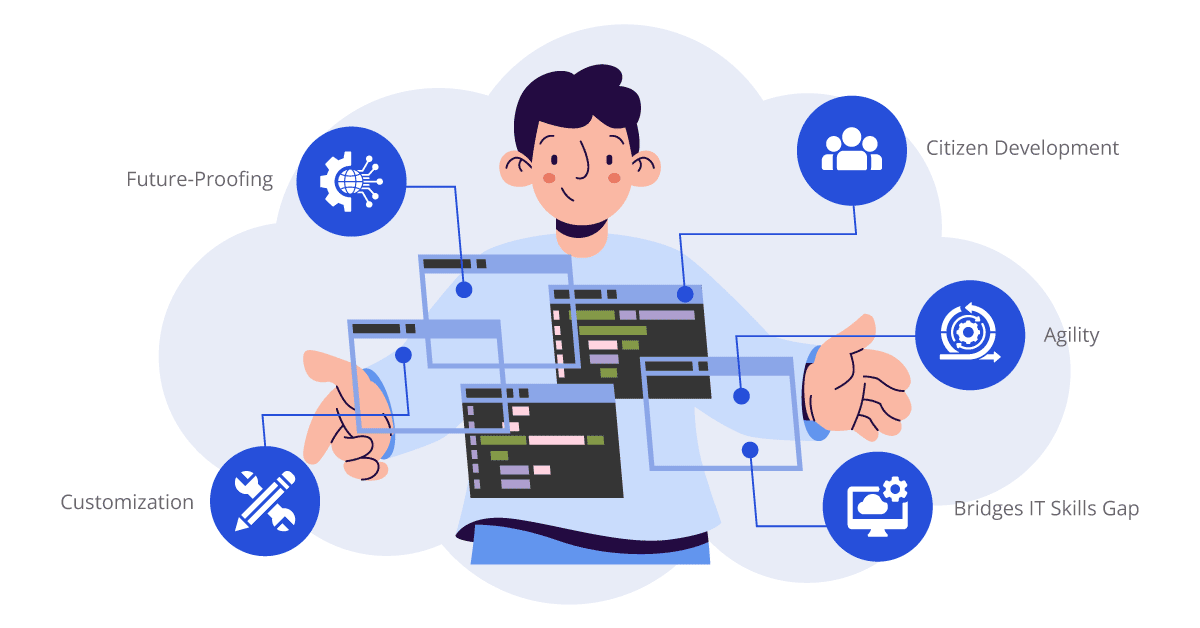
Bridges IT Skills Gap: Low-code platforms enable business users with little or no coding experience to participate in application development. This helps bridge the IT skills gap and reduces dependency on scarce IT resources. Business users can now take an active role in creating and customizing applications, resulting in faster time to market.
Future-Proofing: Low-code platforms provide a future-proof approach to application development. They offer scalability, integration capabilities with existing systems, and the ability to adopt emerging technologies like AI, IoT, and blockchain. This ensures that applications built on low-code platforms can evolve and adapt to future business needs.
Citizen Development: Low-code platforms empower citizen developers within an organization. These are non-technical users who have a deep understanding of the business requirements. By providing a visual and user-friendly development environment, low-code platforms enable citizen developers to actively contribute to application development, reducing the backlog of IT requests and accelerating the delivery of solutions.
Customization: Low-code platforms allow businesses to create custom applications that meet their specific needs, without requiring extensive coding skills or a large development team. This can help businesses to achieve their unique goals and improve their operations.
Agility: Low-code platforms enable businesses to be agile and quickly adapt to changing business needs. With low-code platforms, businesses can experiment and test new ideas quickly, without the need for extensive coding skills or a large development team.
Low-code platforms are an essential tool for businesses that want to improve efficiency, reduce costs, enable rapid innovation, and achieve their unique goals. By simplifying the application development process and reducing the need for expensive development resources, low-code platforms enable midsized businesses to stay competitive in today’s fast-paced digital landscape.
Low-code Platform: Enables Continuous Integration
Yes, low-code platforms can enable continuous integration (CI) in software development. Continuous integration is a software development practice that involves regularly merging all code changes into a central repository and automatically testing them. It allows developers to catch bugs and issues early in the development cycle, which can save time and resources in the long run.
Low-code platforms are designed to simplify and accelerate software development by providing pre-built components and drag-and-drop tools. These platforms can also automate many of the tedious and time-consuming tasks involved in software development, such as testing and deployment.
By using a low-code platform, developers can quickly build and test applications, and then easily integrate them into a CI/CD pipeline. This allows for rapid iteration and deployment of applications, which can help companies stay competitive in fast-moving markets.
In addition, low-code platforms typically provide features such as version control, automated testing, and deployment management, which are essential for successful continuous integration. These platforms can also help developers collaborate more effectively by providing centralized repositories for code and documentation.
Overall, a low-code platform can be a powerful tool for enabling continuous integration in software development, helping companies accelerate their development cycles and deliver high-quality applications more efficiently.
Final Thoughts
As technology continues to rapidly evolve, businesses need to keep up with the pace to stay competitive. However, not every company has the resources to hire a team of developers to create custom software solutions. This is where low-code platforms come in – they provide an easy-to-use and affordable way for businesses to build and deploy software applications without needing extensive coding knowledge.
Low-code platforms offer a range of benefits, including increased productivity, faster time-to-market, and better collaboration between business and IT teams. With the ability to continuously integrate and deploy changes, companies can quickly adapt to evolving business needs and stay ahead of the competition.
If you haven’t considered it, consider incorporating a low-code platform into your tech stack and take advantage of all the benefits it offers.
Get Started with Aonflow iPaaS – Free Trial Available!
Build and deploy your integrations at zero cost. No credit card required!