In today’s fast-paced technology-driven world, businesses and organizations are always on the lookout for new and innovative ways to subsume artificial intelligence (AI) or machine learning (ML) to enhance their working methods internally while driving growth externally.
iPaaS has been a major enabler of data integration and application connectivity for more than a decade. And, now that AI and ML have a place at the table with iPaaS, businesses can experience new frontiers in efficiency, visibility, and creativity. Let’s find out what AI and ML are doing for iPaaS in this blog, along with its impact on data integration and business flows.
Get Started with Aonflow iPaaS – Free Trial Available!
Build and deploy your integrations at zero cost. No credit card required!
The Evolution of iPaaS
According to research by Fortune Business Insights, iPaaS has become one of the fastest-growing segments in the enterprise software market in just eight years.
In 2023, the market for integration platforms as a service (iPaaS) was estimated to be worth USD 10.70 billion. This market is expected to develop at a compound annual growth rate (CAGR) of 25.3% from USD 12.87 billion in 2024 to USD 78.28 billion by 2032. But where did this remarkable journey begin?
IPaaS began in the late 2000s thanks to a rapid increase in cloud computing. With the migration to cloud-based solutions and SaaS applications on the rise, businesses were confronted with extensive efforts necessary for integration between fragmented systems & data stores.
The very first iPaaS came out in 2008. Initially designed as a more approachable iteration of ETL (Extract, Transform, and Load)—the conventional data integration methodology that pulls out the data from multiple sources and combines it into one database. ETL is a full-fledged solution, but most of the time it’s tuned for an IT department workflow and iPaaS offers flexibility with low-code or even no-code configurations, unlocking data integration for many different users.
The proliferation of powerful SaaS tools means huge benefits for businesses, but these apps tend to be very useful in extremely niche cases. They can handpick from a specific variety of specialized tools that suit their taste, similar to how one would pick candies at a store.
But these tools generally work in isolation One app is collecting data in a way that likely will not easily communicate with and share back to other systems, making the broader technology ecosystem fragmented.
When it comes to apps as data silos, they function in isolation which poses a challenge for businesses. Data silos create additional barriers to collaboration and may result in reporting challenges if the proper information is not included, thus hindering decisions on complete or accurate data.
Breaking down these silos and ensuring tighter digital connections between apps is essential to optimize many of our business operations. And this is exactly where iPaaS shines.
Using iPaaS to blend the best-in-breed applications, your organization can establish a streamlined and synchronized tech stack that supports business growth and aligns seamlessly with strategic goals.
For many years, the primary use case of an iPaaS was to integrate numerous applications and data sources. It is a central location where cloud and ground systems can be connected, workflows automated, and data passed to in harmonization. iPaaS has quickly evolved. The modern iPaaS is oriented toward sophisticated integration needs.
The Role of AI and ML in iPaaS
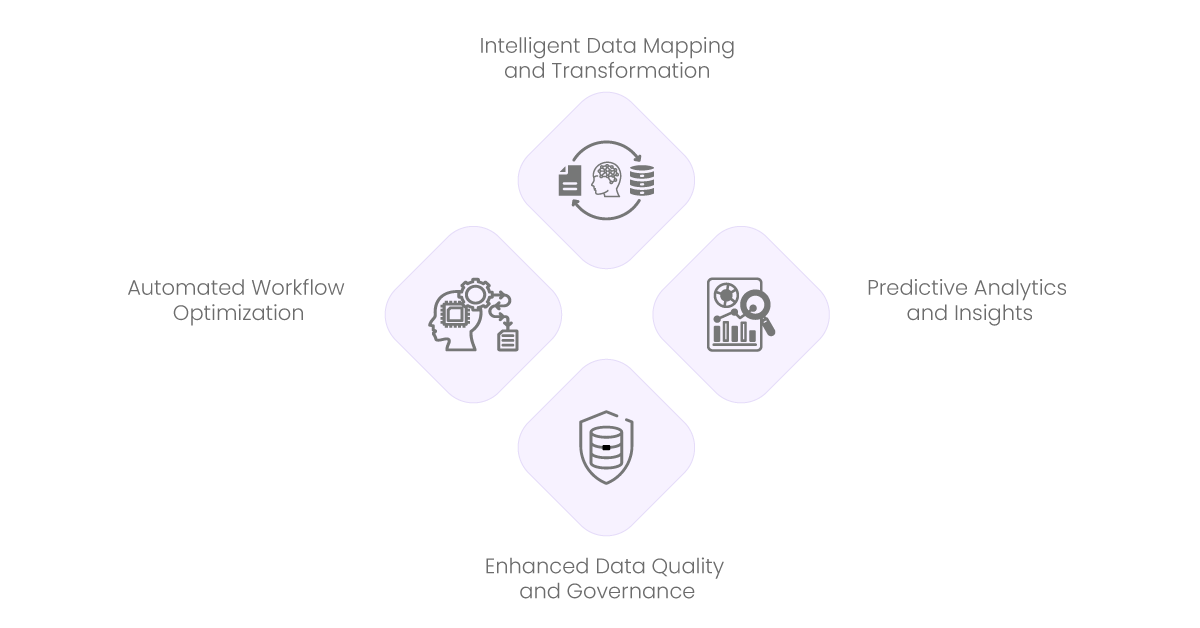
AI and ML technologies are increasingly being integrated into iPaaS platforms to enhance their capabilities and offer advanced features. Here’s how these technologies are making a difference:
1. Intelligent Data Mapping and Transformation
Data mapping and transformation are critical aspects of integration, often involving complex and manual processes. AI-powered iPaaS solutions can automate these tasks with greater accuracy and efficiency. Machine learning algorithms can analyze data patterns and automatically map and transform data between different systems, reducing the need for manual intervention and minimizing errors.
Example: AI-driven tools can identify patterns in data structure and semantics, enabling automated mapping of fields from a CRM system to an ERP system, ensuring that data flows seamlessly without requiring extensive manual configuration.
2. Predictive Analytics and Insights
AI and ML enable predictive analytics, which can provide valuable insights into data trends and future outcomes. By integrating these capabilities into iPaaS, businesses can leverage real-time data to make informed decisions, forecast trends, and optimize operations.
Example: An iPaaS platform with built-in predictive analytics can analyze historical sales data to forecast future demand, helping businesses optimize inventory levels and reduce stockouts or overstock situations.
3. Enhanced Data Quality and Governance
Maintaining high data quality and ensuring governance are essential for effective integration. AI-driven iPaaS solutions can continuously monitor and cleanse data, identifying and addressing inconsistencies, duplicates, and errors. Machine learning models can learn from data quality issues and improve over time, ensuring that data remains accurate and reliable.
Example: An AI-enabled iPaaS can automatically detect and correct data anomalies, such as incorrect customer addresses or duplicate records, improving the overall quality of the integrated data.
4. Automated Workflow Optimization
Workflow automation is a core feature of iPaaS, and AI can take this to the next level. By analyzing workflow patterns and performance, AI algorithms can identify bottlenecks and inefficiencies, suggesting or implementing optimizations to improve workflow efficiency.
Example: AI can analyze the workflow of a customer service process and recommend changes to streamline ticket handling, reducing response times and improving customer satisfaction.
Key Benefits of AI-Enhanced iPaaS
Integrating AI and ML into iPaaS platforms offers several key benefits for businesses:
1. Improved Efficiency and Accuracy
AI and ML technologies automate complex tasks and processes, reducing the need for manual intervention and minimizing errors. This leads to increased efficiency and accuracy in data integration and management.
2. Enhanced Decision-Making
With predictive analytics and real-time insights, businesses can make more informed decisions. AI-driven iPaaS solutions provide valuable data-driven recommendations and forecasts, enabling organizations to respond proactively to changing conditions.
3. Greater Flexibility and Scalability
AI-enabled iPaaS platforms are more adaptable to changing business needs. They can scale seamlessly as businesses grow, accommodating new applications and data sources without requiring extensive reconfiguration.
4. Better Data Governance
AI-driven data quality and governance features ensure that integrated data remains accurate and reliable. This enhances data integrity and supports compliance with regulatory requirements.
5. Cost Savings
By automating manual processes and optimizing workflows, AI-enhanced iPaaS solutions can lead to significant cost savings. Businesses can reduce the need for manual labor, lower error rates, and streamline operations.
Aonflow is the leading integration platform.
You can kick-start by integrating your first-ever workflow in just a matter of minutes.
Implementing AI and ML in iPaaS: Best Practices
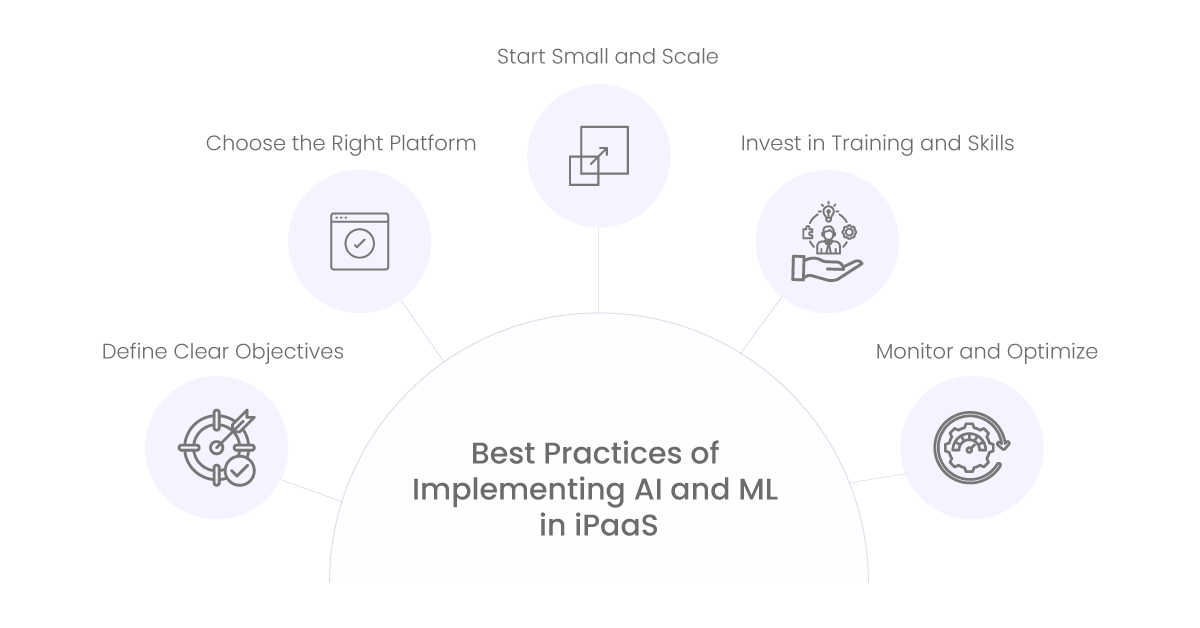
To harness the full potential of AI and ML within your iPaaS environment, adhering to best practices is crucial. These strategies will help you integrate these advanced technologies effectively and ensure they deliver the desired outcomes:
Define Clear Objectives
Begin by clearly outlining your goals and use cases for incorporating AI and ML into your iPaaS. Understanding the specific challenges you aim to address—such as improving data accuracy, enhancing predictive analytics, or automating routine tasks—is essential. By setting precise objectives, you can tailor AI and ML applications to meet your business needs and measure their impact more effectively.
Choose the Right Platform
Selecting the appropriate iPaaS provider is fundamental to successful integration. Evaluate potential platforms based on their AI and ML capabilities, such as built-in machine learning models, support for natural language processing, or advanced data analytics features. Additionally, consider the platform’s scalability, integration options with your existing systems, and the level of support provided. Choosing a platform that aligns with your business requirements and technological goals will set the foundation for a successful implementation.
Start Small and Scale
It’s advisable to initiate your AI and ML journey with a pilot project. This approach allows you to test the capabilities of your iPaaS solution in a controlled setting, assess its performance, and gather insights from initial deployments. Use this phase to identify any challenges, refine your strategies, and make necessary adjustments before rolling out the solution more broadly across your organization. Starting small helps mitigate risks and ensures that you build a solid foundation for scaling up.
Invest in Training and Skills
The successful integration of AI and ML technologies hinges on the skills of your team. Invest in training programs and resources to equip your employees with the knowledge required to utilize these advanced features effectively. This includes understanding how to interpret AI-driven insights, manage machine learning models, and leverage data analytics tools. Empowering your team with the right skills will enhance their ability to maximize the benefits of your iPaaS solution.
Monitor and Optimize
Ongoing monitoring is vital to ensure that your AI-enhanced iPaaS solution continues to perform optimally. Regularly review performance metrics, gather feedback from users, and analyze the effectiveness of the AI and ML integrations. Use this information to make informed adjustments and optimizations, address any issues, and refine the system to better meet your evolving needs. Continuous improvement will help you fully capitalize on the potential of AI and ML, driving long-term success and efficiency in your business processes.
Few Use Cases: Applications of AI in iPaaS
1. Retail: Optimizing Inventory Management
A leading retail chain implemented an AI-powered iPaaS solution to integrate its inventory management system with its e-commerce platform and supply chain. By leveraging machine learning algorithms, the company was able to predict demand patterns, automate inventory replenishment, and reduce stockouts. The result was a 15% increase in sales and a 20% reduction in inventory holding costs.
2. Financial Services: Enhancing Fraud Detection
A major financial institution integrated AI into its iPaaS platform to enhance its fraud detection capabilities. The AI algorithms analyzed transaction patterns and identified suspicious activities with greater accuracy. This led to a 30% reduction in false positives and a significant decrease in fraudulent transactions, improving overall security and customer trust.
3. Healthcare: Streamlining Patient Data Integration
A healthcare provider used an AI-enabled iPaaS solution to integrate patient data from various electronic health record (EHR) systems. The AI algorithms automated data mapping and transformation, ensuring accurate and up-to-date patient information. This improved data quality and enabled better coordination of care, resulting in improved patient outcomes and operational efficiency.
The Future of AI and iPaaS Integration
AI and ML with iPaaS is the new evolution of data integration by bringing both together. As the technology matures, it will enable greater technological advancements and how businesses run their data. Businesses that see the value in AI-rich iPaaS solutions will be able to stand up well against their competition; ultimately, helping these companies stay atop of market trends and maintain a successful growth path.
Combining iPaaS with AI and machine learning can result in revolutionary gains for data integration and business operations. With deep knowledge of and use cases for these advanced technologies, businesses can realize unprecedented levels of efficiency, insight, and innovation in both the near and long-term future.
Get Started with Aonflow iPaaS – Free Trial Available!
Build and deploy your integrations at zero cost. No credit card required!